 EN
EN


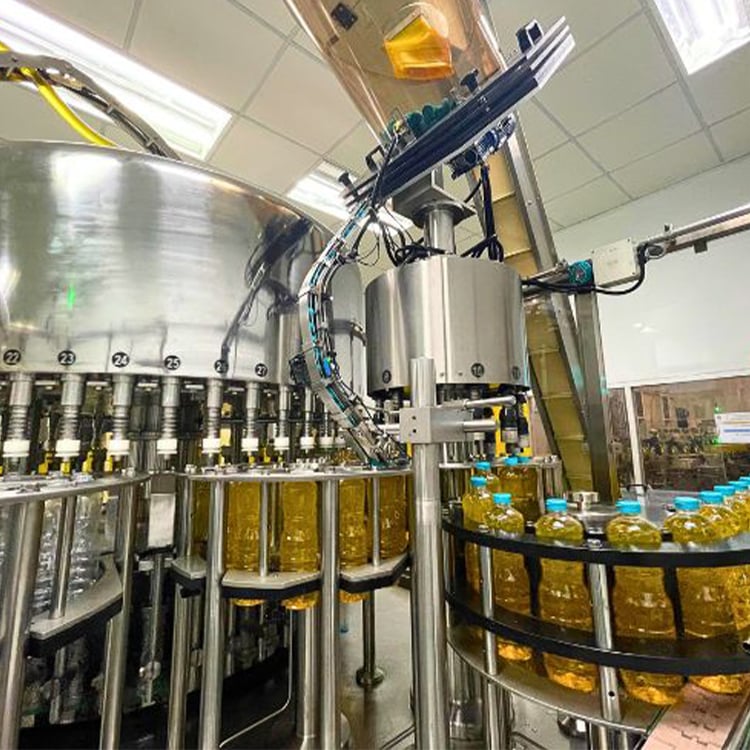
Precision Engineering for Accurate Oil Volume Filling
Achieving consistent fill volumes in oil bottling requires a careful balance between metering technology, calibration, and real-time feedback. Two dominant mechanisms—volumetric and piston-based—offer distinct accuracy trade-offs depending on oil viscosity, throughput requirements, and cost sensitivity.
Volumetric vs. Piston-Based Oil Filling Mechanisms: Accuracy Trade-offs Explained
Volumetric filling systems—typically using magnetic or mass flow meters—dispense a preset volume and deliver accuracy within ±0.5% to ±1%. They perform reliably with low-viscosity oils such as cooking and mineral oils, where consistent density supports stable flow measurement. However, accuracy degrades with higher-viscosity products due to slippage, air entrapment, and laminar flow disruptions.
Piston-based fillers use a reciprocating cylinder to draw and discharge a fixed volume, achieving tighter tolerances of ±0.2% to ±0.5% (Ponemon 2023). This makes them especially suited for high-value edible oils, industrial lubricants, and pharmaceutical-grade liquids—where even minor overfill directly erodes margins. While generally slower than volumetric systems, piston fillers offer superior consistency for viscous fluids and are easier to clean and reconfigure. Operators can adjust stroke length to accommodate varying container sizes, enhancing flexibility during product changeovers. The optimal choice hinges on viscosity profile, required output rate, and financial tolerance for giveaway.
Calibration, Sensor Feedback, and ±0.5% Accuracy Validation Under Real Production Conditions
Sustaining ±0.5% accuracy under real-world production conditions demands integrated calibration protocols and responsive sensor architecture. Photoelectric or laser sensors detect container presence and position, triggering the PLC to initiate and terminate filling—preventing waste from missed or misaligned bottles. Servo-driven valves and frequency inverters dynamically modulate flow based on live input from volume metering units, compensating for pressure fluctuations in real time.
Gravimetric checkweighers serve as the gold standard for validation: they weigh each filled container against the target, flagging deviations for immediate corrective action. Top-tier piston fillers validated under actual line conditions consistently achieve ±0.5% volume consistency across thousands of cycles (Ponemon 2023). Temperature compensation algorithms further refine accuracy by adjusting for thermal expansion or contraction of the oil—critical when ambient or process temperatures fluctuate. Regular cleaning of sensors and nozzles prevents drips and maintains hygienic integrity, particularly with sticky or dense oils. This end-to-end validation not only ensures compliance with labeling regulations (e.g., FDA 21 CFR Part 101 and EU Directive 76/211/EEC) but also reduces giveaway, delivering measurable ROI for large-scale producers.
Dynamic Speed Control in Automatic Oil Filling Machines
PLC-Driven Adaptive Filling Cycles: Maintaining Accuracy at 30–120 Bottles/Minute
Modern automatic oil filling machines rely on programmable logic controllers (PLCs) to execute adaptive filling cycles that preserve volume accuracy across wide speed ranges—from 30 to 120 bottles per minute. As throughput increases, the PLC continuously fine-tunes valve timing and flow rate using real-time sensor feedback. A closed-loop system monitors every fill event and corrects deviations within milliseconds; at high speeds, even a 0.1-second timing drift could result in significant overfill or underfill.
The PLC stores multiple product recipes, enabling rapid, error-free changeovers between oil types without manual recalibration. Integration of pressure and flow sensors helps suppress foaming and spillage—common issues when handling volatile or aerated oils. This intelligent coordination of logic, sensing, and actuation ensures that ±0.5% fill accuracy remains constant regardless of line speed variations.
Frequency Inverters and Servo Valves: Enabling Responsive Flow Regulation for Oil
Frequency inverters (also known as Variable Frequency Drives or VFDs) regulate pump motor speed to match instantaneous demand—rather than operating at a fixed rate. This dynamic control cuts energy consumption by up to 30% and reduces mechanical wear. Servo valves complement this capability by modulating nozzle aperture with millisecond precision, delivering granular control over the oil stream.
Together, these components allow a single machine to handle oils spanning a broad viscosity range—from thin vegetable oils (~30 cP) to heavy gear lubricants (>1,000 cP)—while preserving fill weight consistency. When bottle size or target volume changes mid-run, the inverter and servo valve respond instantly, maintaining both productivity and precision without requiring downtime or recalibration.
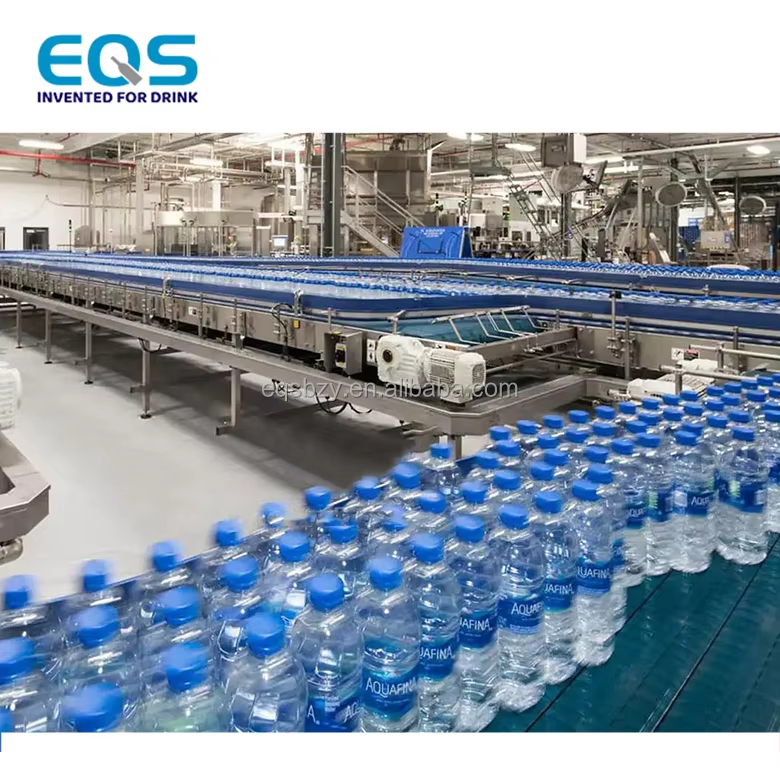
Oil-Specific Design Factors: Viscosity, Temperature, and Air Management
How Viscosity Impacts Meniscus Stability, Pump Efficiency, and Fill Consistency
Viscosity is the primary determinant of flow behavior in automated oil filling. Higher-viscosity oils resist flow, delay meniscus formation, and increase susceptibility to air entrapment—leading to inconsistent fills and inaccurate volume delivery. Pump selection must therefore align with rheological properties: piston pumps excel with thick oils but may shear sensitive formulations; gear pumps maintain steady flow but lose accuracy below ~500 cP.
Temperature shifts compound these effects—a 10°C variation can alter viscosity by 20–50%, potentially causing fill weight discrepancies exceeding 1.5% in uncontrolled environments. To counteract this, advanced oil filling machines integrate dual-path flow meters and pressure-compensated valves that auto-adjust to real-time viscosity changes, sustaining ±0.5% accuracy across seasonal formulation shifts and ambient temperature swings.
Pre-Fill Vacuum, Drip Control, and Temperature Compensation in High-Performance Oil Filling Machines
High-performance oil filling systems incorporate three interdependent features specifically engineered for viscous liquids:
- Pre-fill vacuum chambers evacuate air from containers before dispensing, eliminating bubble-induced volume errors
- Nozzle drip control systems employ reverse suction valves to retract residual oil immediately after cutoff, preventing post-fill drips and contamination
- Temperature compensation algorithms dynamically adjust fill duration using real-time viscosity data from inline sensors
These technologies operate synergistically: vacuum treatment promotes clean meniscus formation, while temperature-adjusted flow rates preserve the balance between speed and accuracy. For high-viscosity oils like ISO VG 320 gear lubricants, this integrated approach reduces fill variation to ≤0.3%—even at speeds exceeding 100 containers per minute.
FAQ
What is the main factor affecting the choice between volumetric and piston-based filling systems?
The main factor is the viscosity of the oil. Volumetric systems work well with low-viscosity oils, while piston-based fillers are better for higher-viscosity oils.
How is real-time accuracy maintained during high-speed filling operations?
Real-time accuracy is maintained by using PLCs to adjust valve timing and flow rate based on sensor feedback, ensuring consistency even at varying speeds.
What technologies help in managing oil viscosity variations?
Dual-path flow meters, pressure-compensated valves, and temperature compensation algorithms adjust in response to real-time viscosity changes, maintaining accuracy.
Why are pre-fill vacuum chambers used in oil filling machines?
Pre-fill vacuum chambers eliminate air from containers before dispensing, which helps prevent volume errors caused by bubbles.