 EN


What Materials Work Best on a Fruit Juice Packaging Machine?
For a fruit juice packaging machine, there is no single material that fits every recipe or line. PET can suit lightweight bottles, glass can offer a strong barrier, and multilayer cartons or pouches can suit particular distribution needs. The right choice depends on the juice, filling process, required shelf life and the equipment designed to handle the pack. Start with those conditions, then qualify the actual container and closure together.
From a packaging selection perspective, two different questions matter. What material holds the juice? And what materials touch the juice inside the equipment? Both affect a fruit juice packaging machine, but each needs its own specifications and evidence.
Start with the process, not just the package
Describe whether the juice is clear or contains pulp, its acidity, filling temperature, intended storage temperature and expected shelf life. A chilled product has different packaging and hygiene requirements from an ambient product. Hot filling, aseptic filling and cold filling also call for different validated arrangements; a suitable container alone does not make a process safe or shelf stable.
Give the supplier an actual bottle, carton or pouch drawing, including closure and dimensions. Ask whether the fruit juice packaging machine is designed for that format, its material and the intended production rate. The filler, transfer components and sealing equipment all need to work with the sample, not merely with its nominal volume.
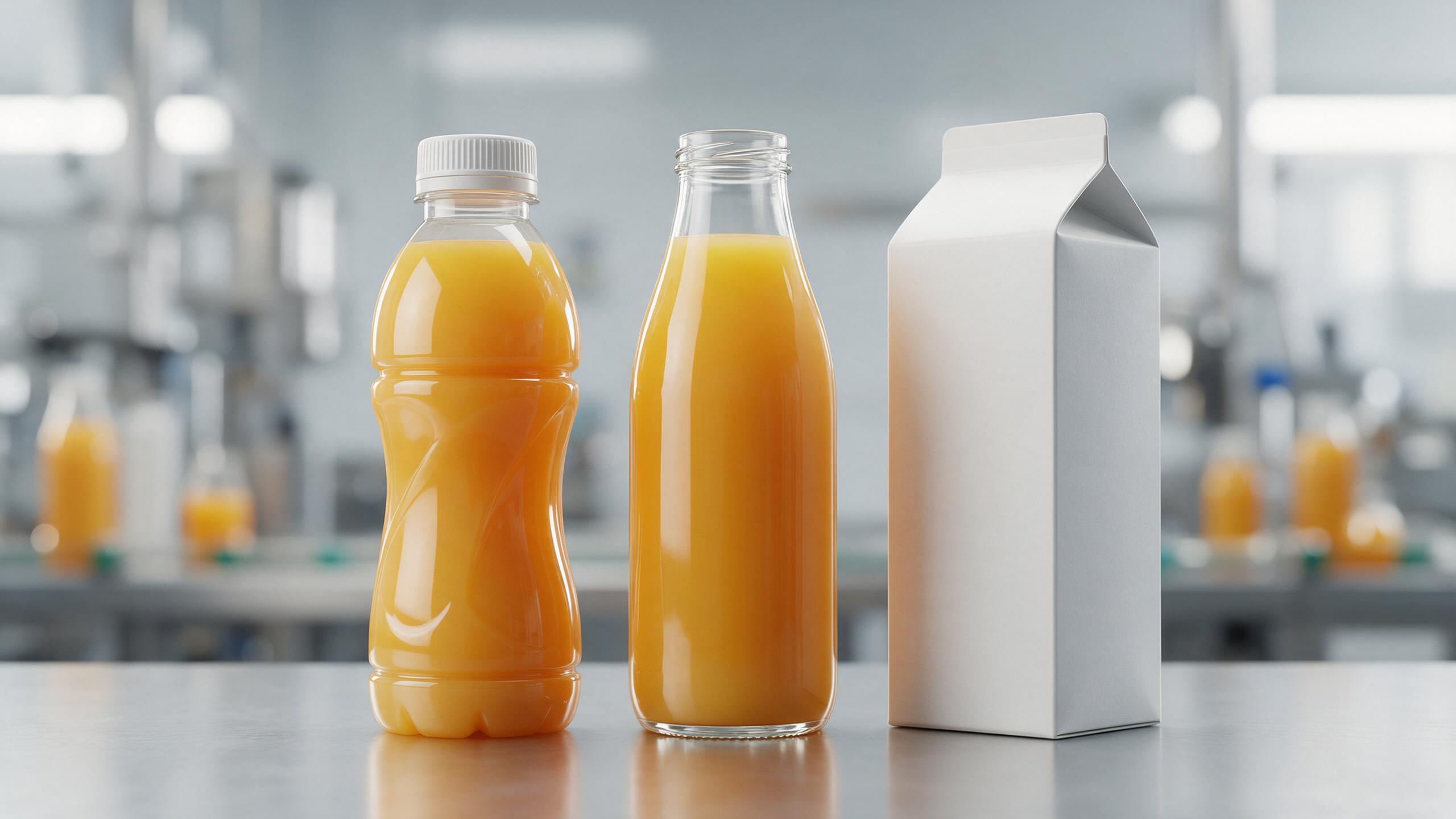
PET bottles: lightweight, but check heat and barrier
Polyethylene terephthalate, or PET, is commonly considered for lightweight juice bottles. It can offer convenient handling and a range of shapes, while transparent packaging allows the product to be seen. A fruit juice packaging machine configured for PET bottles must still match the neck finish, bottle stability and cap type. Thin or unusually shaped bottles may need different guides or handling arrangements.
Heat is a critical distinction. Ordinary PET bottles should not be assumed suitable for hot filling. Heat-set or otherwise heat-resistant designs may be candidates, but the container supplier must confirm the permitted temperature and cooling conditions for the specific bottle and closure. Test filled containers for deformation and closure integrity under the actual process. PET barrier performance also depends on the bottle design and any added barrier layers; validate it against the juice and shelf-life target.
Glass bottles: strong barrier, heavier handling
Glass provides a strong barrier to gases and is often chosen when a rigid, premium-looking container is important. It is heavier than many plastic alternatives and can break, so a fruit juice packaging machine handling glass needs compatible bottle transfer, impact control and a site procedure for glass breakage. Confirm the bottle's thermal-shock suitability for the planned filling and cooling sequence rather than assuming every glass bottle behaves alike.
Check the closure as carefully as the container. The neck finish, cap liner, closure application and seal inspection must be specified together. If the line handles both glass and PET, ask which change parts, settings and tests are required; a shared nominal capacity does not establish interchangeability.
Cartons and flexible pouches: assess the full structure
Cartons and pouches are systems made from layers, not a single generic material. A carton may combine paperboard for stiffness with polymer layers and, depending on the application, a barrier layer. Some aseptic packages use polyethylene on the food-contact surface. Pouches can use laminated films selected for sealing, strength and barrier performance. Ask the packaging supplier for the actual layer structure and its suitability for the product and process.
A fruit juice packaging machine intended for bottles cannot be presumed to form or seal a carton or pouch. Forming method, film or blank dimensions, sealing surfaces and closure presentation must match the specific equipment. For aseptic packaging, the complete processing, sterilization and filling system requires its own validation. Do not infer an ambient shelf life from the material name alone.
Compare materials against line conditions
- Product protection: define oxygen and light sensitivity, target shelf life and storage conditions; request barrier data for the proposed structure.
- Temperature: confirm filling, holding and cooling conditions for the container, seal and closure. Use the supplier's limits for the exact design.
- Handling: review container shape, weight, rigidity, neck dimensions and transfer points on the fruit juice packaging machine.
- Sealing: match cap or film specifications to the sealing equipment and agree on an inspection method for the finished pack.
- Commercial fit: compare packaging supply, freight, changeover requirements, local recycling routes and total operating costs using project-specific quotations.
Recyclability depends on the complete pack and local collection and processing systems. A multilayer design can offer useful protection, but its end-of-life route may differ from that of a single-material bottle. Ask for local evidence instead of relying on a broad label.
What about the materials inside the machine?
Juice-contact tanks, piping, valves, seals and hoses are separate from the consumer package. Stainless steel is often considered for product-contact metal surfaces, while elastomers and plastics may be used in seals or flexible components. The grade, surface finish and compatibility of every contact component must be checked against the juice, cleaning chemistry, temperature and contact time. More expensive metal alone does not establish a hygienic design.
For a juice filling machine, request a product-contact material list, supplier declarations for the target market, weld and surface-finish information where relevant, and a cleaning plan. Food-contact rules can apply to processing equipment as well as packaging. The plant's food safety team should determine which regulations and documentation apply to the finished system in its destination market.
Qualify the pack before ordering at scale
Run a representative sample on the proposed fruit juice packaging machine with the intended juice or a suitable agreed test product. Include startup, normal running and changeover. Inspect container stability, filling consistency and seal condition; for hot-filled packs, include the planned cooling and handling sequence. For pulp-containing juice, agree on tests that reflect the particles and viscosity rather than using water as the only acceptance medium.
Record the container and closure specifications, process temperatures, sample lots, test method and acceptance criteria. Shelf-life and distribution trials should reflect the conditions the product will encounter. If a pack fails, identify whether the issue lies in the material, package design, machine setup or process before changing specifications.
Which material should you choose?
Choose PET when low container weight and bottle handling suit the project, with heat and barrier performance verified. Consider glass when its barrier and presentation justify the added weight and breakage controls. Consider cartons or pouches when their structure and a compatible dedicated line meet the product and distribution requirements. In every case, select the fruit juice packaging machine and packaging as a matched system, and document the conditions under which the combination was tested.