 EN


How Does a Jar Labeling Machine Handle Wide Mouth Containers?
A wide mouth does not by itself tell you how a jar will travel or where a label will sit. A jar labeling machine handles the container by controlling its body and base, presenting a suitable surface to the applicator, and pressing the label into place. The actual setup depends on the jar's shape, label position and production conditions—not just the opening diameter.
For a packaging-line planner, the useful question is whether a specific jar can be guided, labeled and discharged consistently with its actual lid and label. A short, broad jar may have a stable base, but its shoulders, raised seams or flexible walls can leave little flat labeling space. Confirm those details before choosing the equipment.
Start with the body, not the mouth
Measure the outer diameter of the body at the intended label height, overall height, base diameter, lid diameter and the height of the usable panel. Note any taper, ribs, embossing or changes in diameter between the base and shoulder. Include filled weight and whether the container is glass or plastic: both affect how a jar moves and responds to pressure.
A jar labeling machine for a cylindrical body can rotate the jar while dispensing a pressure-sensitive label. A wide lid may extend beyond the body, however, so guides or an overhead device must clear the cap without pushing the jar out of position. A container that is round at the base but tapered at the label panel should not automatically be treated as a straight cylinder.
For a full or partial wrap, measure the circumference at the actual application height. On a truly cylindrical panel, circumference is approximately diameter multiplied by pi. Decide whether the label ends need a gap or overlap, and agree that detail with the label supplier. This simple check is more useful than sizing a label from the mouth opening.
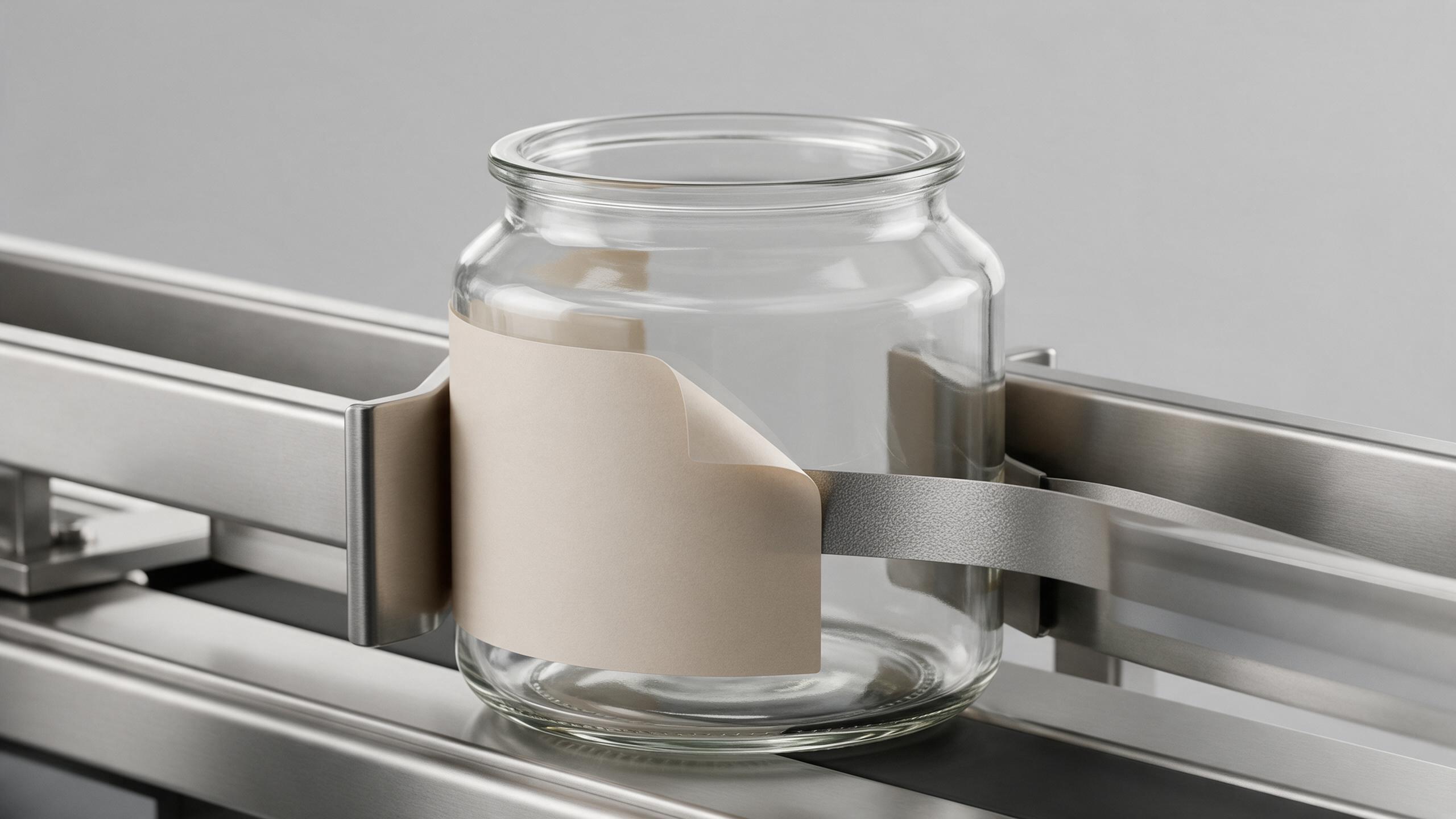
How the jar is controlled through the labeling station
1. Infeed and spacing
Jars arrive on a conveyor or are placed into a fixture, depending on whether the system is automatic or semi-automatic. In an inline configuration, adjustable side guides can keep the body aligned as it enters the application zone. A spacing device may separate jars so the sensor and applicator have time to respond to each one.
With short containers, guide height matters: rails that contact a lid instead of the body may steer the jar differently from rails set on the sidewall. The jar labeling machine supplier should confirm contact points and clearance using samples, especially when a lid is wider than the label panel. Delicate or flexible containers may need gentler contact or a different handling arrangement.
2. Detection and label release
A sensor detects each jar and triggers the applicator at the selected position. Depending on the configuration, timing is adjusted against conveyor speed and the desired leading edge. The operator should check both vertical placement and where the label begins around the jar, since these are separate requirements.
If artwork must face a particular direction relative to a seam, handle or other feature, say so before ordering. A basic jar labeling machine may not provide the orientation control needed for that task. Ask the supplier how the feature will be detected and how placement will be verified on the actual container.
3. Wrap and wipe-down
For a round body, a belt, roller or other approved mechanism can rotate the jar as the label is dispensed. A wipe-down device then presses the label against the surface. The dispensing speed, container rotation and contact pressure need to work together; a mismatch can show up as skew, folds or a raised edge.
Excess pressure is not a substitute for stable handling. Test a filled jar as well as an empty one, and inspect the label after the adhesive supplier's recommended dwell time. A jar labeling machine must suit the real container surface, adhesive, label material and production environment; a clean demonstration on a different jar does not establish compatibility.
Wide-mouth shapes that need extra attention
Tapered jars: A straight rectangular label may wrinkle or drift when the panel changes diameter from top to bottom. Some applications use a shaped label and a dedicated setup for taper. Bring both the proposed artwork and container to a trial rather than assuming that a standard wrap will conform.
Short jars with large lids: Check that the applicator can reach the body without contacting the cap. If the visible sidewall is too short for the required information, a lid label or separate top-label station may be worth evaluating. Confirm that the cap surface and closure position are suitable for the intended label.
Square or irregular jars: A jar labeling machine designed for continuous round wrapping may not control flat faces or corners in the same way. Front-and-back application, fixtures or other handling may be more appropriate. State whether the label should cross a corner, since that affects both material selection and application.
Ribbed or flexible walls: Raised features and wall deflection can make contact uneven. Try the intended label stock on the actual surface and check for lifting after storage under the expected conditions. The label supplier should confirm adhesive suitability for the container material and surface state.
Plan changeovers and line interfaces
If several jar sizes share one labeling machine, make a size matrix before comparing quotations. Include minimum and maximum body dimensions, lids, label dimensions, formats, target rates and whether labels go on the side, top or both. Ask which guide settings are adjustable and which components must be changed. Record the changeover steps and operator access required; a broad size range on paper does not prove quick switching.
Also check the conveyor height, direction of travel and available space between capping and downstream packing. A jar labeling machine that runs acceptably alone still needs a stable supply from upstream and a clear discharge path. Compare the proposed operating rate with the rest of the line, using the same jar and test conditions rather than a headline speed alone.
Use a sample run to set acceptance criteria
Send representative empty and filled jars, closures and production label rolls to the prospective supplier. Include the extremes of the planned range, as well as any jar with a pronounced taper or overhanging lid. Before the trial, agree the intended operating rate, sample quantity and acceptable limits for label height, skew, wrap gap and defects.
Observe infeed stability, sensor triggering, application and discharge. Inspect labels for folds, edge lift and placement variation; check them again after the agreed dwell period. Run each important format and a changeover, and document any adjustments or additional parts needed. A trial identifies conditions to write into a purchase specification; it is not a substitute for the supplier's operating and safety instructions.
When requesting a quotation, provide the dimensioned jar drawing, label artwork, filled weight, line layout and acceptance targets. Ask the supplier to identify the proposed handling method and any format-specific parts. With those details, the right jar labeling machine can be evaluated against the actual wide-mouth package rather than its name alone.