 EN
EN


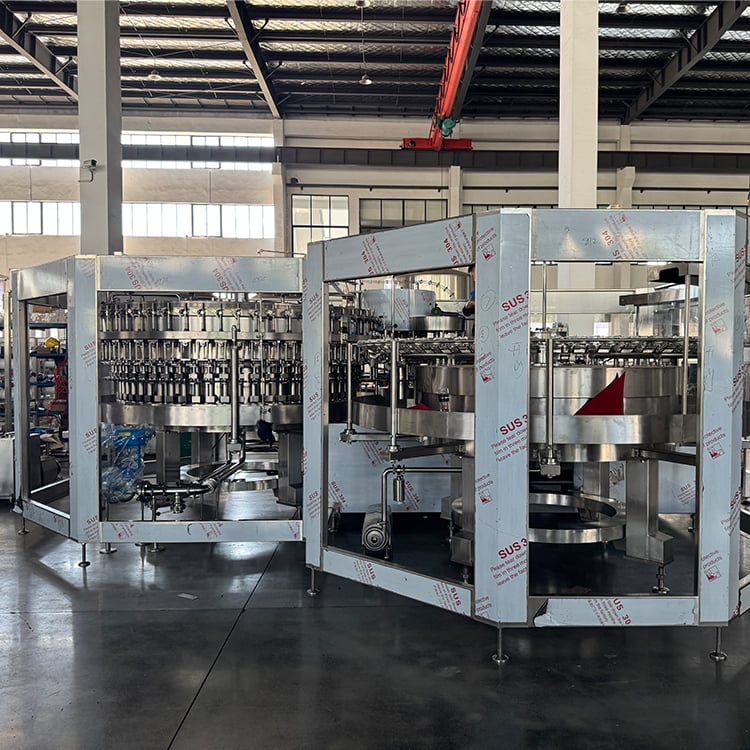
How High-Speed Carbonated Filling Machines Preserve CO₂ Under Pressure
Counter-pressure filling: physics, process control, and CO₂ retention
Counter-pressure filling is the foundational principle enabling high-speed carbonated filling machines to retain dissolved CO₂. It works by pre-pressurizing the bottle with CO₂ (or inert gas) to match the pressure in the filler bowl—typically 3–5 bar—before liquid introduction. This equilibrium prevents the sudden pressure drop that triggers violent CO₂ breakout and foam formation. Once stabilized, the product valve opens and beverage flows smoothly under gravity, minimizing gas loss.
Modern systems use precision pressure sensors, proportional valves, and PLC-driven automation to maintain this balance at speeds exceeding 24,000 bottles per hour (BPH). A key enhancement is bottle-neck pre-pressurization, which further stabilizes the filling environment and improves process consistency.
| Filling Condition | CO₂ Retention Rate | Foam Rejection Rate | Line Speed |
|---|---|---|---|
| Without Pre-Pressurization | ~85% | 12% | 24,000 BPH |
| With Pre-Pressurization | ~96% | 3% | 24,000 BPH |
Source: 2023 industry performance study on high-speed carbonated beverage lines.
Integrating pre-pressurization brings CO₂ retention close to theoretical limits—reducing product waste, ensuring consistent mouthfeel, and lowering dissolved oxygen pickup, which extends shelf life and preserves flavor integrity.
Temperature management during high-speed carbonated filling to minimize gas loss
Temperature directly governs CO₂ solubility: at 0°C, water holds roughly 1.7× more CO₂ than at 20°C. To maximize retention, carbonated filling machines chill product to a narrow 2–4°C range before filling. Even a 1°C rise during transfer can initiate gushing and measurable gas loss. Leading systems deploy multi-stage heat exchangers, jacketed piping, and insulated filler bowls to maintain thermal stability from batching through fill.
The post-fill window—between liquid entry and capping—is equally critical. Immediately after filling, bottles pass under a CO₂ or nitrogen blanket that displaces ambient air and inhibits warming. Synchronized filler-to-capper transfers—often completed in under three seconds—preserve the cold chain. Combined with counter-pressure, this thermal discipline routinely achieves CO₂ retention above 95%, significantly outperforming ambient atmospheric lines (78% retention, Beverage Production Quarterly, 2022). Real-time temperature probes across the line feed data to the HMI, enabling proactive adjustments to chilling or speed before thermal drift impacts quality.
Foam control in carbonated filling: root causes and real-time mitigation strategies
Foam compromises fill accuracy and CO₂ retention. Primary drivers include pressure instability, turbulent flow, residual oxygen in the bottle, and temperature fluctuations. Unchecked, foam causes underfills, spillage, and unnecessary gas loss.
Modern carbonated filling machines deploy a three-tiered defense:
- Oxygen removal: Bottle pre-evacuation combined with CO₂ purging eliminates 90–95% of residual O₂—the main nucleation site for foam.
- Laminar flow control: Pressure-regulated filling valves ensure smooth, non-turbulent product delivery—cutting foam rejection from 12% to 3% when paired with pre-pressurization.
- Adaptive sensing: Real-time flow, pressure, and foam-level sensors feed an adaptive control loop that automatically adjusts fill speed or valve timing if foam begins to rise.
These integrated safeguards ensure precise volume delivery and minimal gas loss—even at 24,000 BPH—without sacrificing speed or consistency.
Key Design and Operational Features of Modern Carbonated Filling Machines
Precision pneumatic and mechanical systems enabling reliable high-speed carbonated filling
At the heart of modern carbonated filling machines lies a servo-driven electro-pneumatic architecture. High-resolution regulators maintain constant back pressure in the filler bowl—suppressing CO₂ breakout even at speeds approaching 60,000 BPH. Multi-channel magnetic flow meters, operating in closed-loop feedback mode, deliver volumetric accuracy within ±0.5% (Beverage Technology Report, 2023). Optical level detectors and pressure transducers monitor every fill cycle in real time, triggering automatic rejection of under- or over-filled containers.
Mechanically, lightweight, quick-change filling valves and star-wheel assemblies support rapid format transitions without compromising seal integrity. Advanced double pre-evacuation and pressurization chambers reduce oxygen pickup to less than 20 ppb—critical for flavor stability and shelf-life extension. Together, these features enable unprecedented throughput and reliability—achieving line speeds once considered technically unattainable.
Seamless integration into CSD lines: synchronization with rinsing, capping, and labeling
A high-speed carbonated filling machine functions as a synchronized node—not a standalone unit—within a fully integrated CSD line. Centralized PLC control coordinates it precisely with upstream bottle rinsers and downstream cappers, labelers, and coders. Electronic cam profiles and virtual master axes replace mechanical couplings, allowing the filler to dynamically track rinser and capper speeds with millisecond precision.
This integration slashes changeover times to under 15 minutes via recipe-driven servo adjustments that reposition all star-wheels and guides simultaneously. Magnetic torque-controlled screw capping heads—linked directly to the filler’s control system—apply uniform torque to every cap, preventing seal failures that could compromise carbonation. Bottles move continuously from rinse to fill to cap in seconds, with production data aggregated across stations for real-time OEE monitoring. Tight synchronization ensures CO₂ volume remains stable from fill to final seal—preserving product quality at scale.
Innovations Driving Efficiency: Aseptic PET Filling and Pasteurizer-Free Carbonated Filling
Aseptic PET bottle filling for carbonated beverages: technical feasibility and contamination safeguards
Cold aseptic PET filling is now viable for carbonated beverages because low-temperature processing better retains CO₂ than hot-fill alternatives. Modern carbonated filling machines integrate sterile carbonators and positive-pressure aseptic chambers to prevent recontamination post-filling. Bottles and caps undergo validated chemical sterilization—using peracetic acid or hydrogen peroxide—followed by sterile-water rinsing. HEPA-filtered air maintains ISO Class 5 cleanroom conditions throughout the fill zone.
Continuous environmental monitoring, automated clean-in-place (CIP) cycles, and microbiological verification support uninterrupted production runs exceeding 150 hours. These controls make it possible to safely fill sensitive formulations—such as fruit-juice blends or protein-fortified sodas—without thermal degradation, preserving taste, aroma, and nutritional integrity while extending shelf life.
Pasteurizer-free carbonated filling: energy savings, shelf-life implications, and validation requirements
Pasteurizer-free carbonated filling eliminates the tunnel pasteurizer, reducing energy consumption by up to 30% and avoiding water-intensive thermal treatment. Instead, ultra-high-temperature (UHT) sterilization occurs before filling—ensuring microbial safety without downstream heat exposure. This approach saves floor space, lowers utility costs, and removes thermal stress on packaging and formulation.
Shelf-life validation requires rigorous microbiological challenge testing—including worst-case pathogen spiking and accelerated aging—to confirm product stability without pasteurization. When process parameters—including UHT dwell time, aseptic chamber integrity, and post-fill oxygen ingress—are fully validated, aseptic carbonated filling delivers shelf lives equivalent to traditional pasteurized products—without sacrificing carbonation, flavor, or safety.
Frequently Asked Questions (FAQs)
What is counter-pressure filling?
Counter-pressure filling is a method that pre-pressurizes bottles with CO₂ or inert gas to match the pressure of the filler bowl, minimizing CO₂ breakout and foam formation during filling.
Why is temperature management critical during carbonated filling?
Temperature directly affects CO₂ solubility, with colder liquids retaining more gas. Maintaining a temperature range of 2–4°C prevents gas loss and preserves beverage quality.
How do modern systems prevent foam during filling?
Advanced systems use oxygen removal, laminar flow control, and adaptive sensing to mitigate foam formation, ensuring accurate fills and minimal waste.
What is the advantage of aseptic PET filling for carbonated beverages?
Aseptic PET filling prevents recontamination and preserves carbonation, taste, and nutrition without the thermal stress of traditional hot-fill methods.
What are the benefits of pasteurizer-free carbonated filling?
Pasteurizer-free filling reduces energy and water consumption while achieving microbial safety through ultra-high-temperature sterilization before filling.