 EN
EN


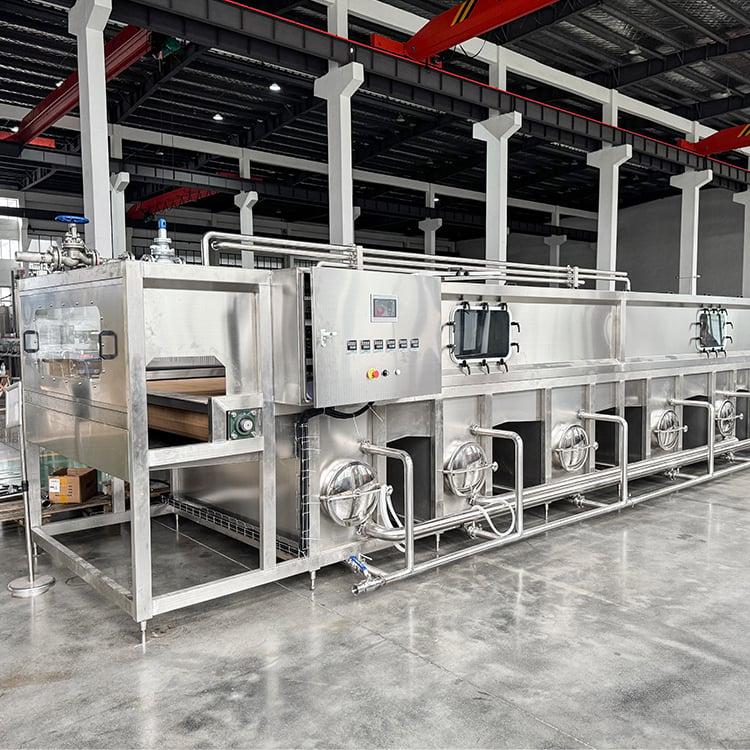
How Tunnel Pasteurization Ensures Microbial Safety Across Beverage Types
Pasteurization Units (PU) as the Scientific Standard for Safety Validation
Pasteurization Units (PU) serve as the quantifiable benchmark for microbial kill—defined as one minute of exposure at 60°C. The beverage industry uses PU calculations to validate that every product receives a lethal thermal dose against pathogens and spoilage organisms. For example, beer typically requires 15–30 PU for stability, while high-acid juices like apple cider often demand 100 PU or more. This scientific approach replaces guesswork with precision: producers set tunnel temperature and belt speed based on PU targets to ensure even the coldest point—the bottle center—reaches the required lethality. Without PU validation, batches risk under-pasteurization, compromising safety and shelf life. The universality of PU enables equipment manufacturers to design tunnel systems that deliver consistent thermal profiles across varying bottle sizes and line speeds. Food safety audits increasingly require documented PU data, making this standard essential for compliance and consumer trust.
Impact of pH, Sugar Content, and Viscosity on PU Delivery in Kombucha, Cider, and Juice
Product composition directly influences heat transfer and microbial resistance—meaning the same PU target cannot be applied uniformly. Kombucha’s low pH (2.5–3.5) enhances the thermal sensitivity of spoilage yeasts, allowing lower PU values. In contrast, high-sugar cider increases heat capacity and viscosity, slowing thermal penetration and requiring longer dwell times. Juices with pulp or high viscosity similarly impede convective heat flow, creating cold spots; a juice with 40% pulp may need 20% more PU than its clear counterpart to achieve equivalent microbial reduction. To compensate, modern tunnel pasteurizers adjust water spray temperatures and coverage dynamically. Variable-frequency drives (VFDs) modulate belt speed in real time, maintaining precise PU delivery despite fluctuations in viscosity or line conditions. This product-specific calibration avoids both over-pasteurization—which degrades flavor—and under-pasteurization—which risks spoilage—making it indispensable for kombucha, cider, and premium juices where sensory quality is non-negotiable.
Engineering Efficiency: Energy Optimization and Precision Control in Modern Tunnel Pasteurizers
Modern tunnel pasteurization systems integrate advanced engineering solutions to maximize energy efficiency while ensuring precise control over microbial lethality. Leading manufacturers prioritize technologies that reduce operational costs without compromising beverage safety.
Heat Recovery Systems and Variable-Frequency Drives for Sustainable Throughput
Heat recovery systems capture thermal energy from cooling zones to preheat incoming beverages, reducing steam consumption by up to 40%. When paired with variable-frequency drives (VFDs) on conveyor systems, these technologies dynamically adjust motor speeds based on production demands—eliminating energy waste during ramp-up periods and low-throughput scenarios. This synergy lowers utility costs while maintaining optimal PU delivery across diverse container formats and fill volumes.
PLC-Driven Zone Management for Consistent Temperature Profiling and Real-Time PU Monitoring
Programmable Logic Controller (PLC) systems enable granular temperature control across individual spray zones, automatically compensating for ambient fluctuations. Integrated sensors track actual beverage temperatures—not just spray water temps—feeding data into algorithms that calculate PU accumulation in real time. This closed-loop control prevents under-processing risks while avoiding over-processing that degrades sensory attributes in thermally sensitive products like craft beer or probiotic beverages. Operators receive instant alerts for deviations exceeding preset PU tolerances, enabling immediate corrective action.
Tunnel Pasteurization in Practice: Balancing Safety, Sensory Quality, and Production Scale
Engineers constantly weigh microbial safety against sensory preservation when designing tunnel pasteurization lines. Every beverage has a unique thermal tolerance, and high-volume production amplifies the cost of any temperature misstep. A misapplied zone can degrade flavor compounds, alter color, or introduce unwanted cooked notes—while inadequate heating risks spoilage and recalls.
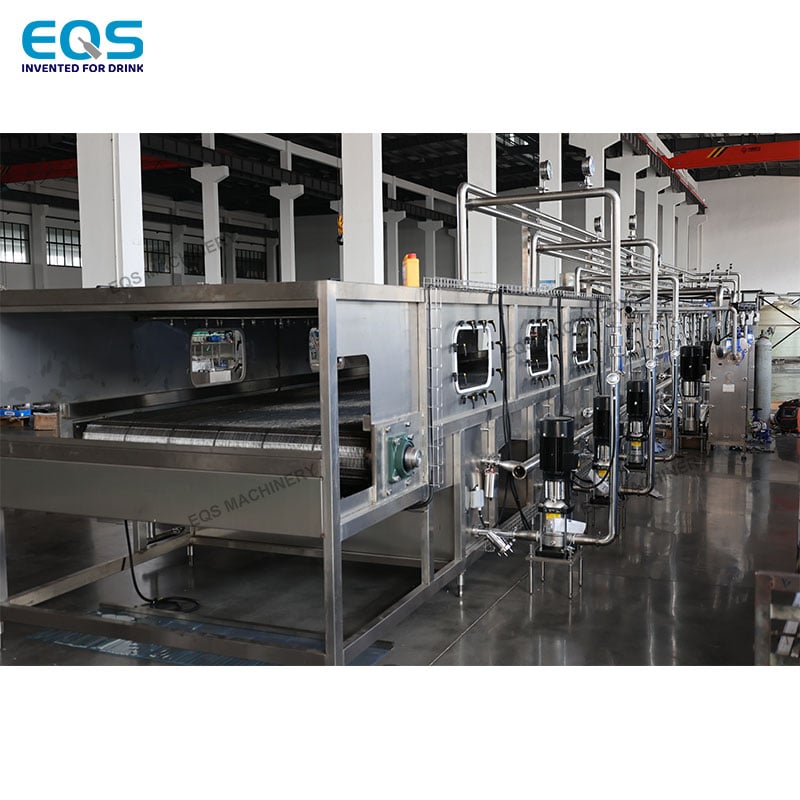
Thermal Sensitivity Trade-offs: Beer vs. RTD Tea vs. Carbonated Soft Drinks
Beer is the most thermally fragile: its hop aromatics and yeast-derived esters degrade quickly above 60 °C, so PU targets are tightly capped at 15–20 PU to preserve crispness. Ready-to-drink (RTD) teas—often near-neutral in pH and enriched with sugars—require 30–50 PU for microbiological stability, yet over-pasteurization creates a “stewed” taste. Carbonated soft drinks, benefiting from low pH and high sugar content, tolerate 50+ PU without noticeable sensory loss, making them ideal for high-throughput tunnel pasteurization. Balancing these differences means configuring separate temperature zones for each product line—an added layer of engineering complexity that protects brand integrity across scale.
Operational Excellence: Critical Parameters That Define Tunnel Pasteurization Performance
Achieving consistent safety and quality requires precise control over several interdependent variables within the tunnel pasteurization system. Temperature is foundational: the beverage must reach and hold within a target range (typically 60–75 °C) for a defined duration to deliver the required PU. Flow rate is equally critical—it governs residence time per zone; too fast reduces PU delivery, too slow limits throughput. The temperature profile across preheating, holding, and cooling zones must be managed to prevent thermal shock, which can crack glass bottles or deform PET containers. Continuous monitoring of conveyor speed, spray water temperature, and pressure ensures uniform thermal treatment across all units. Finally, PU calculations must account for the beverage’s specific heat and density—as well as container geometry—to validate that the lethal effect on target pathogens is consistent throughout the batch. Mastering these parameters directly reduces spoilage risk, minimizes energy waste, and preserves sensory fidelity.
Frequently Asked Questions
What is a Pasteurization Unit (PU)?
A Pasteurization Unit (PU) is a measure that quantifies the thermal treatment applied to beverages to ensure microbial safety. It represents one minute of exposure at 60°C.
How do pH, sugar content, and viscosity affect pasteurization?
These factors impact heat transfer and microbial resistance. Low pH increases thermal sensitivity, sugar content can slow heat penetration, and high viscosity requires longer pasteurization times.
Why is precise control important in tunnel pasteurization?
Precise control ensures that beverages are neither under- nor over-processed, maintaining both safety and sensory quality. It reduces the risk of spoilage and energy waste, preserving product integrity.
What technologies enhance energy efficiency in tunnel pasteurization?
Heat recovery systems and variable-frequency drives (VFDs) help enhance energy efficiency by capturing thermal energy and optimizing motor speeds according to production demands.
Table of Contents
- How Tunnel Pasteurization Ensures Microbial Safety Across Beverage Types
- Engineering Efficiency: Energy Optimization and Precision Control in Modern Tunnel Pasteurizers
- Tunnel Pasteurization in Practice: Balancing Safety, Sensory Quality, and Production Scale
- Operational Excellence: Critical Parameters That Define Tunnel Pasteurization Performance