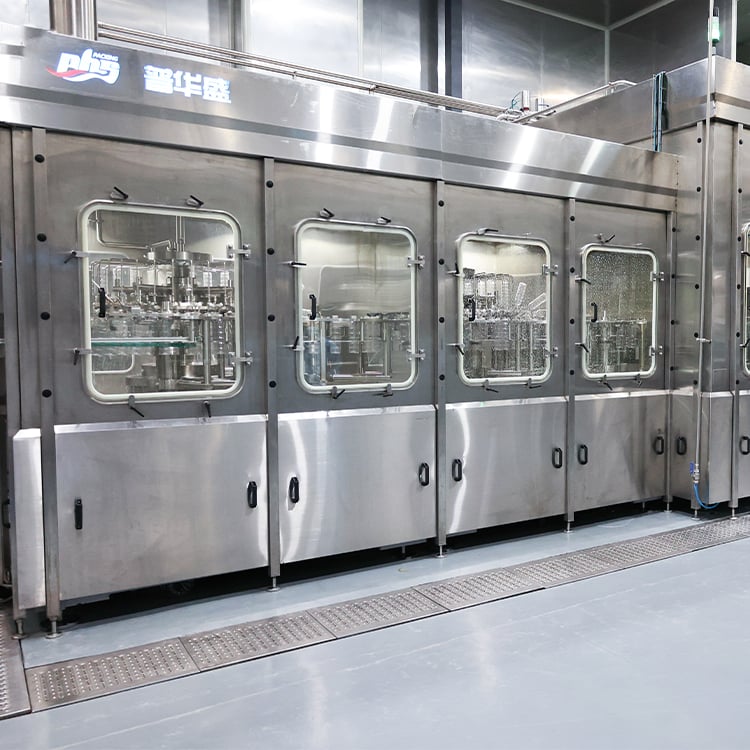
Achieving consistent high‑hygiene performance in modern liquid packaging machine environments does not rely on individual standalone components. Instead, it depends on a dual‑core system: a stable physical barrier that blocks external environmental contaminants, and standardized validation procedures that sustain qualified hygiene conditions throughout every production run.
Engineers assessing packaging line performance focus on how ultra‑clean filling machines integrate high‑hygiene barrier structures, food‑grade material specifications, and continuous validation protocols to fully protect sensitive beverage and liquid‑food products.
High‑Hygiene Barrier Design and Material Standards
The complete high‑hygiene protection system centers on the filling chamber. HEPA‑filtered unidirectional airflow forms a stable positive‑pressure ISO 5 working zone. Dead‑leg‑free product pipelines eliminate hidden corners where microorganisms may accumulate and reproduce.
All product‑contact parts adopt 316L food‑grade stainless steel with precision surface finishing to minimize biofilm adhesion and accumulation. Elastomeric sealing components comply with food‑grade standards to prevent substance precipitation and ensure no impact on product purity. Non‑contact filling nozzle design avoids direct contact between nozzles and bottle mouths, eliminating a major source of cross‑contamination during filling.
Microbial Risk Mitigation and Validation
Hardware configuration alone cannot guarantee long‑term stable hygiene performance; the entire ultra‑clean filling process requires systematic validation and regular verification. Initial equipment qualification is completed through standardized media fill tests to ensure zero contaminated units in batch production simulation.
Real‑time environmental monitoring continuously records viable microorganisms and suspended particle data. Automated CIP and SIP cycles effectively reduce surface microbial loads. Compliance with food‑oriented quality management systems and data integrity standards ensures all batch production records are secure, tamper‑proof and fully traceable for routine quality audits.
Intelligent Control Systems and Real‑Time Optimization
Modern production lines are equipped with high‑sensitivity sensors at pre‑filling, filling and post‑sealing stations to monitor full‑process operational status. Once process parameters deviate — such as abnormal pressure fluctuation inside the filling enclosure — the central control system triggers automatic responses instantly.
The system can adjust airflow speed, execute targeted local sanitization, and automatically reject unqualified products. Real‑time process intervention intercepts potential non‑conforming products before final inspection, effectively reducing raw material waste and repeated processing workload—whether operating on a standard bottled line or an integrated juice filling setup.
Seamless Integration and Traceability
Packaging equipment delivers maximum operational value when integrated into digital production systems. Universal communication protocols support stable data interconnection with manufacturing execution systems and enterprise management platforms.
Each packaged product is assigned an independent digital record, covering all process data from equipment sanitization, filling parameters to final sealing and filling weight. Accurate batch‑level traceability enables precise quality management and targeted product handling, avoiding large‑scale unnecessary production losses.
Measurable Efficiency Gains in Production Facilities
Upgrading to a standardized ultra‑clean system comprehensively improves production throughput, dosing accuracy and continuous operation stability. The equipment achieves higher production capacity while maintaining stable hygiene standards, and high‑precision dosing effectively reduces raw material consumption and product loss, serving as a practical alternative to high‑investment long‑shelf filling configurations.
| Performance Metric |
Traditional Filling Line |
Ultra‑Clean System |
Operational Impact |
| Fill Accuracy |
±0.5% |
±0.15% |
Lower product giveaway |
| Average Downtime |
45 minutes |
35 minutes |
23% reduction per shift |
| Throughput Speed |
200 units/min |
300+ units/min |
Higher line productivity |
| Annual Product Waste |
$120,000 |
$30,000 |
Major cost savings |
Selecting the Equipment for Your Facility
Selecting suitable ultra‑clean packaging equipment requires comprehensive evaluation of product adaptability, production capacity and long‑term operational stability. Production teams need to match pipeline structure with beverage viscosity and shear sensitivity, verify that equipment capacity supports future production expansion, and prioritize hygienic structural design compatible with efficient cleaning cycles.
Evaluating intelligent control functions, energy‑saving operation performance and professional after‑sales support ensures the equipment maintains stable operation, full compliance and cost efficiency throughout its service life.
Hygiene‑Focused Packaging Solutions with EQS
EQS provides professional ultra‑clean filling machine solutions tailored for beverage and liquid‑food production lines. Combining high‑precision dosing technology, intelligent automation and standardized hygienic design, EQS helps manufacturers enhance product safety, reduce unplanned downtime and achieve stable production scaling. With reliable manufacturing capacity and complete supply chain support, EQS delivers stable and practical packaging equipment solutions for liquid food production enterprises.
FAQ
What is the core system responsible for achieving consistent high-hygiene performance in modern liquid packaging machines?
Consistent high-hygiene performance depends on a dual-core system consisting of a stable physical barrier that blocks external environmental contaminants and standardized validation procedures that sustain qualified hygiene conditions throughout every production run.
How do high-hygiene barrier designs maintain a clean environment within the filling chamber?
The filling chamber is protected by HEPA-filtered unidirectional airflow that forms a stable positive-pressure ISO 5 working zone, alongside dead-leg-free product pipelines that eliminate hidden corners where microorganisms can accumulate.
What specific material standards and hardware features are used in product-contact parts to prevent contamination?
All product-contact parts adopt 316L food-grade stainless steel with precision surface finishing to minimize biofilm adhesion, compliant food-grade elastomeric seals to prevent substance precipitation, and a non-contact filling nozzle design that avoids direct contact between nozzles and bottle mouths.
How are microbial risks managed and validated in ultra-clean filling processes?
Microbial risks are managed through systematic validation using standardized media fill tests, continuous real-time environmental monitoring of viable microorganisms and suspended particles, automated clean-in-place and sterilization-in-place cycles, and compliance with data integrity standards for tamper-proof batch records.
What efficiency and performance gains do ultra-clean systems provide compared to traditional filling lines?
Ultra clean systems improve fill accuracy from plus or minus 0.5 percent to plus or minus 0.15 percent, reduce average shift downtime by 23% from 45 minutes to 35 minutes, increase throughput speed from 200 units/min to 300+ units/min, and decrease annual product waste from $120,000 to $30,000.
 EN
EN